Shift Left in IT Operations: Integrating Security and Quality into Front-Line Triage
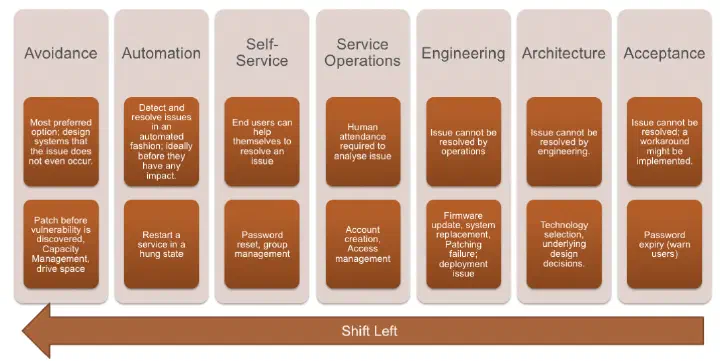
In traditional enterprise IT support models, incidents and security alerts follow a sluggish escalation hierarchy: Tier 1 logs the ticket, Tier 2 investigates basic diagnostics, and Tier 3 engineering specialists are finally paged to perform root-cause analysis and remediation. This reactive pipeline is slow, expensive, and fundamentally ill-suited for modern cybersecurity, where every minute an active vulnerability or misconfiguration persists increases breach exposure.
Shift Left is a strategic service transformation that pushes knowledge, diagnostic automation, and security remediation as close to the initial point of contact as possible.
Traditional Support (Escalation Bottleneck)
[User / Alert] ---> [Tier 1: Triage] ---> [Tier 2: Diagnostic] ---> [Tier 3: Engineer / SecOps Fix]
                     (Hours/Days)           (Days/Weeks)              (Costly, Strained Resource)

Shift Left Model (Immediate, Automated Resolution)
[User / Alert] ---> [Self-Service Automation / Tier 1 Armed with Runbooks] ===> [Instant Resolution]
                           |
                           +---> [Tier 3 Focuses on Automated Guardrails & Prevention]
Reversing the Burden of Proof in Service Delivery
At the heart of the Shift Left philosophy is an inversion of proof:
- In legacy models, the burden rests on the business customer to report when a service is degraded or non-compliant.
- Under Shift Left, the service organization continuously and proactively demonstrates that services meet changing security, compliance, and performance baselines before end users experience friction.
Core Operational and Security Pillars
- Codified Security Runbooks: Complex security assessments and standard remediations (e.g., certificate renewals, IAM permission adjustments, suspicious login quarantines) were packaged into automated scripts and clear decision trees for Level 1 support teams.
- Secure Offshore Operational Enablement: Established vendor contracts, secure virtual desktop infrastructure (VDI), and rigorous data privacy boundaries to enable an offshore operations team in India to handle 24/7 front-line support safely without exposing core production secrets.
- Automated Baseline Verification: Deployed continuous automated checks across servers and endpoints, reporting deviations from security baselines (unpatched packages, disabled firewalls, open ports) directly to Level 1 operators for rapid remediation.
- Knowledge Democratization & Self-Healing: Built an interactive knowledge portal and automated self-healing scripts that resolve common user issues (such as password resets, token synchronization, and VPN re-authentication) instantly without human intervention.
Strategic Outcomes
By shifting resolution leftward, our organizations achieved dramatic improvements in agility and security posture:
- Drastic Mean Time to Resolution (MTTR) Reduction: Routine security requests and incident tickets that previously took 48+ hours were resolved in under 15 minutes.
- Tier 3 Engineering Offload: Freed senior architects and security engineers from repetitive firefighting, allowing them to focus on high-value architecture, threat modeling, and proactive defenses.
- Elevated Customer Satisfaction: Business units experienced transparent, predictable IT services with minimal operational friction.
Shift Left transforms IT service delivery from a reactive cost center into an agile, security-first organizational enabler.